
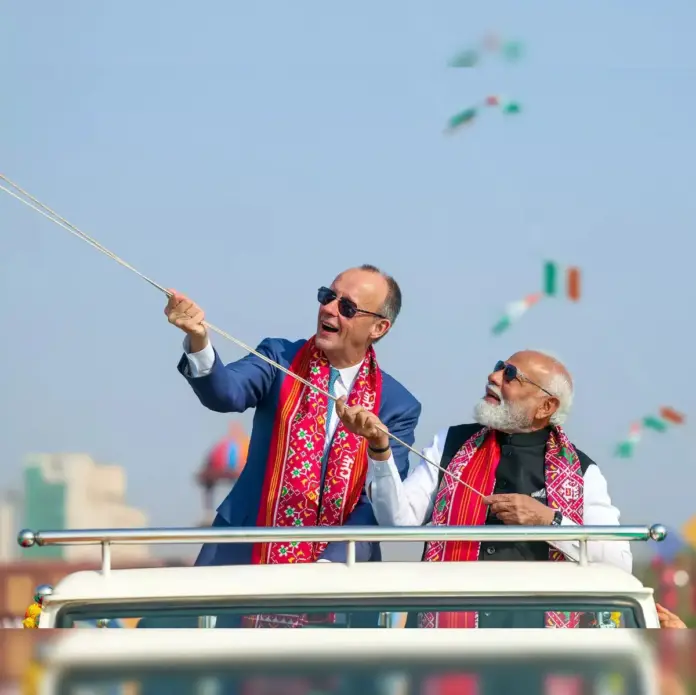

As Brussels dithers, Germany advances—using the EU–India Free Trade Agreement as a vehicle for industrial repositioning, capital realignment, and a signal to markets that Europe’s Asian future may lie in New Delhi, not Beijing.
Merz in India: More Than a Courtesy Visit
Friedrich Merz, head of Germany’s CDU, was welcomed in Ahmedabad with honors usually reserved for heads of state. Officially, it was a party visit. Unofficially, it was groundwork—paving the way for what could become one of Europe’s most geopolitically strategic free trade deals in recent memory.
The EU–India Free Trade Agreement has long lingered in the shadows of diplomatic ambiguity. But Merz’s appearance signals something else: a calculated move by Germany to reposition its export machine away from China, without appearing to break with Brussels, and without overly pleasing Washington.
Financial Markets Decode the Geopolitical Subtext
While diplomats speak in platitudes, capital does not. Since the renewal of talks surrounding the EU–India Free Trade Agreement, financial signals have begun shifting:
- Indian equity funds with EU exposure have surged 14% since October, Bloomberg data shows, with industrials, semiconductors, and infrastructure plays leading the way;
- German 10-year Bund yields ticked down slightly (–4 bps) during Merz’s visit, a sign of investor appetite shifting toward Asia-facing growth assets;
- India’s 5-year sovereign CDS spreads are in gradual decline, reflecting improved perception of political stability, quietly underwritten by Berlin’s warm overtures.
These signals may seem minor—but taken together, they sketch a familiar picture: markets are preparing for a realignment in capital flows, led once again by German industrial interests cloaked in European diplomatic language.
The Quiet Exit from China Accelerates
The unspoken context here is clear: Germany is accelerating its decoupling from China. What began as a “China +1” strategy is morphing into a full pivot to India for many mid-sized manufacturers, particularly in automotive components, machinery, and chemical processing.
According to the Asian Development Bank, EU foreign direct investment in India rose 27% between 2023 and 2025, with Germany accounting for over half of that capital. Simultaneously, new industrial projects in China by German firms have slowed dramatically, despite official denials from Berlin and EU institutions.
The markets have noticed. Indian subsidiaries of German firms—Bosch India, Siemens India—have outperformed the Nifty 50 index by up to 8% over the past quarter, in anticipation of new joint ventures and technology transfers.
The EU: Legal Shell, German Engine
The European Commission may be driving the process on paper, but the substance is clear: Germany is setting the agenda, and the EU acts as a legal amplifier. This echoes previous trade deals (notably with Mercosur and South Korea), where Germany’s economic aims shaped the final outcome, while Brussels provided the diplomatic camouflage.
The EU–India Free Trade Agreement is less about free trade, and more about industrial hedging. It is Germany insuring itself against a volatile China, an unreliable America, and a Europe unable—or unwilling—to industrialize itself coherently.
Let’s be blunt: the EU is now a transmission belt for German capital strategy, not a geopolitical actor in its own right.
Markets Read Between the Lines—and Follow Berlin
Behind the headlines and official communiqués, the markets have understood what this agreement really means: not a triumph of diplomacy, but a reallocation of productive capital, away from a Eurasia shaped by Russian war and Chinese assertiveness, toward an India eager to play both sides.
The EU–India Free Trade Agreement is not yet signed, but its effects are already being priced in. And while Brussels continues to sermonize about “strategic autonomy”, Germany moves—quietly, deliberately—and the capital markets follow.