
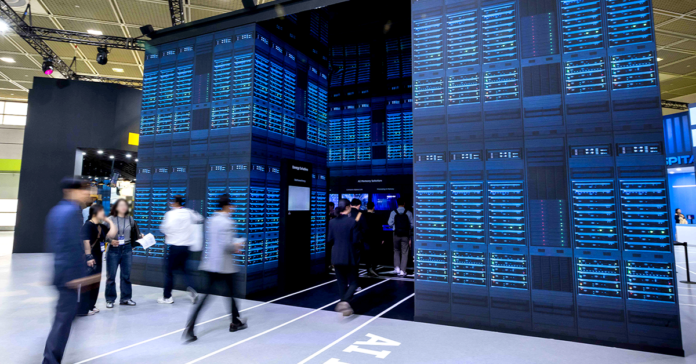

AI data center deployment is entering a new phase as SK Telecom forms a strategic partnership with Supermicro and Schneider Electric. The three companies signed a memorandum of understanding at MWC26 in Barcelona.
The agreement focuses on developing a prefabricated modular solution for artificial intelligence data centers (AIDC). This model aims to shorten construction timelines and improve infrastructure efficiency. Moreover, the collaboration addresses supply chain constraints affecting large-scale AI infrastructure projects.
As global demand for AI computing rises rapidly, operators require faster and more flexible deployment strategies. Therefore, modular infrastructure could become a key component of next-generation data center expansion.
AI Data Center Deployment Through a Modular Architecture
The partnership introduces a prefabricated modular approach to AI data center deployment. Under this model, computing servers and infrastructure components integrate into pre-manufactured modules.
Traditionally, data centers use a steel-reinforced concrete construction process. In that method, operators install servers and infrastructure after completing the building structure. However, this sequential approach often delays deployment timelines.
In contrast, modular construction allows companies to assemble standardized units off-site. Operators can then install these units rapidly within the facility. As a result, organizations can accelerate project delivery and improve cost control.
Furthermore, modular designs support phased expansion. Companies may add modules as demand increases. Consequently, businesses can limit large upfront capital expenditures.
Strategic Roles of the Three Partners
Each partner contributes specialised expertise to the project.
First, SK Telecom provides operational knowledge from its expanding AIDC initiatives. The company has increasingly positioned artificial intelligence as a primary growth engine.
Second, Supermicro supplies high-performance GPU-optimised servers. These systems support advanced AI training and inference workloads. Moreover, the hardware can adapt to specific enterprise computing requirements.
Finally, Schneider Electric delivers mechanical, electrical and plumbing infrastructure. Its engineering capabilities ensure reliable power distribution and cooling systems. Such infrastructure remains essential for high-density AI workloads.
Together, the three companies aim to deliver a fully integrated AI infrastructure solution.
Market Context: Rising Investment in AI Infrastructure
Global technology firms are rapidly expanding their AI infrastructure capacity. Consequently, hyperscalers require faster construction cycles and scalable architectures.
SK Telecom has already committed significant capital to artificial intelligence development. The company plans cumulative AI-related investment of approximately ₩5 trillion by 2030. In addition, management has set a similar target for AI-driven revenue over the same period.
Recent financial disclosures highlight the company’s scale. Consolidated revenue reached ₩8.79 trillion during the first half of 2025. Wireless services accounted for roughly 74% of total revenue.
Despite these strong fundamentals, the company continues to pursue new AI infrastructure initiatives. Therefore, this partnership supports its broader transformation into an AI-centric technology company.
Investor Reaction and Market Performance
The announcement generated mixed market reactions. SK Telecom shares declined 3.05% on the day of the announcement.
Interestingly, peer telecom stocks showed limited movement. Liberty Broadband gained modestly, while KT and Frontier Communications remained relatively stable.
Historically, SK Telecom’s AI announcements have produced small average price movements of around 0.26%. However, the current decline represents a larger short-term reaction.
Nevertheless, the long-term strategy remains consistent. Over the past year, SK Telecom has launched several AI initiatives. These include hyperscale AI models, AI agents, and industry-specific AI services.
The new modular data center collaboration marks a shift toward full-stack AI infrastructure development.
Long-Term Outlook for AI Infrastructure Expansion
Demand for artificial intelligence infrastructure continues to accelerate globally. Hyperscale computing, generative AI models, and enterprise AI adoption require enormous processing capacity.
Therefore, the industry increasingly prioritises faster data center construction methods. Modular infrastructure provides several advantages. These include faster deployment, scalable capacity, and improved cost efficiency.
Through its partnership with Supermicro and Schneider Electric, SK Telecom aims to deliver global-scale AI data center deployment solutions.
If successful, the model could attract hyperscale cloud operators seeking flexible infrastructure expansion. Consequently, the initiative may strengthen SK Telecom’s competitive position in the global AI ecosystem.