
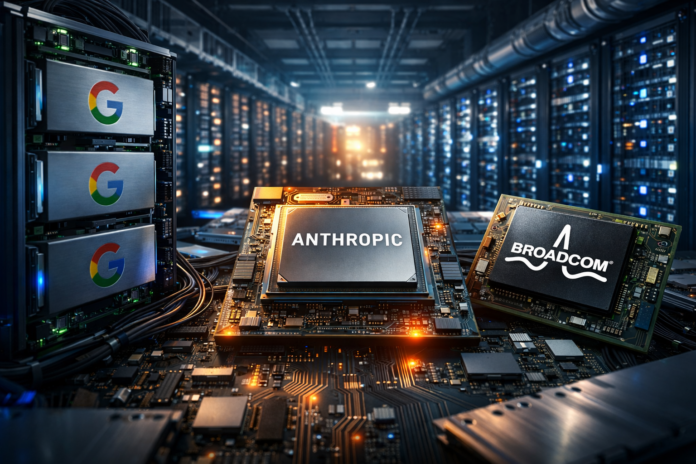

Anthropic chip deals are rapidly emerging as a defining trend in the artificial intelligence sector. These agreements with Google and Broadcom reflect a strategic shift towards securing long-term computing capacity.
Indeed, AI development increasingly depends on access to advanced semiconductor technologies. Therefore, partnerships of this scale are no longer optional but essential for competitive positioning.
Anthropic chip deals and the growing importance of compute power
The rapid expansion of generative AI has significantly increased demand for high-performance computing. As a result, companies must secure reliable access to specialised chips.
Moreover, training advanced AI models requires substantial computational resources. These resources are typically delivered through GPUs or custom-built accelerators.
Google plays a dual role in this ecosystem. On the one hand, it provides cloud infrastructure. On the other hand, it develops proprietary chips such as TPUs.
Meanwhile, Broadcom focuses on semiconductor design and networking solutions. Consequently, it enables the scalability required for large AI clusters.
Why Anthropic chip deals could reach hundreds of billions
At first glance, the valuation of these agreements may seem excessive. However, several factors justify the scale.
Firstly, AI training costs continue to rise sharply. Each new model generation requires more data and more compute power.
Secondly, infrastructure investments are long-term commitments. Therefore, multi-year agreements naturally accumulate into substantial financial volumes.
In addition, hyperscale data centres require continuous upgrades. This further increases capital expenditure over time.
A competitive race for AI dominance
Anthropic chip deals also highlight intensifying competition across the AI landscape. Companies are no longer competing solely on model performance.
Instead, access to infrastructure has become a decisive advantage. For example, major players are forming deep partnerships to secure compute capacity.
Furthermore, vertical integration is becoming more common. Businesses now aim to control both software and hardware layers.
As a result, smaller entrants may struggle to compete. The cost of entry continues to rise significantly.
Broadcom’s strategic role in AI expansion
Although less visible, Broadcom remains a critical player in the AI ecosystem. Its technologies support the backbone of modern data centres.
Specifically, the company designs custom chips tailored to hyperscaler requirements. Additionally, it provides networking components essential for AI workloads.
Therefore, its involvement in Anthropic chip deals signals a broader infrastructure strategy. It is not limited to processors alone.
Market implications of Anthropic chip deals
These developments carry significant implications for the wider technology sector.
- Barriers to entry are increasing due to capital intensity
- Supply chains are becoming more concentrated
- Strategic partnerships are replacing transactional relationships
Consequently, the industry is moving towards consolidation. Only well-funded organisations can sustain such investment levels.
Infrastructure becomes the core battleground
Anthropic chip deals demonstrate a fundamental shift in the AI industry. Innovation alone is no longer sufficient to maintain leadership.
Instead, companies must secure long-term access to computing resources. Therefore, infrastructure is now at the centre of competitive strategy.
Looking ahead, this trend is likely to accelerate. As demand for AI grows, so too will the importance of semiconductor partnerships.