
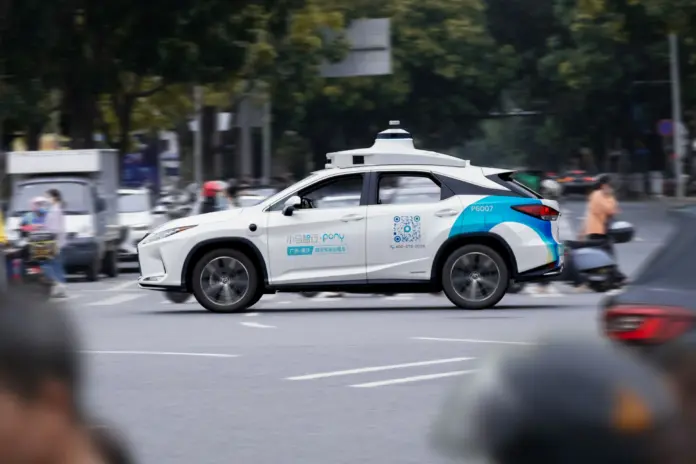

Introduction to PonyWorld 2.0 Autonomous Driving
PonyWorld 2.0 autonomous driving marks a significant evolution in the development of self-improving AI systems for mobility. The latest upgrade enhances how autonomous vehicles learn, adapt, and scale efficiently. Moreover, it introduces a structured framework that improves both safety and operational performance.
Pony.ai launched this advanced platform to accelerate commercial deployment across global markets. Consequently, the system now supports a more scalable and economically viable model for Level 4 (L4) autonomous driving.
PonyWorld 2.0 Autonomous Driving and Self-Improving AI
PonyWorld 2.0 autonomous driving introduces a new paradigm centred on continuous self-improvement. Unlike traditional models, it enables AI systems to identify weaknesses independently. As a result, development cycles become faster and more targeted.
The platform integrates three core capabilities:
- Self-diagnosis of system limitations
- Targeted real-world data collection
- Enhanced training focused on complex scenarios
Therefore, the system refines its performance through a structured feedback loop. This approach reduces reliance on manual intervention while improving learning precision.
A Scalable Model for Global Autonomous Deployment
Pony.ai aims to deploy over 3,000 autonomous vehicles by the end of 2026. These vehicles will operate across 20 cities globally. Notably, nearly half of these locations will be international markets.
This expansion reflects a shift in industry priorities. Previously, companies focused on proving technological feasibility. However, the emphasis now lies on scalability, efficiency, and consistent performance.
PonyWorld 2.0 supports this transition by improving unit economics and operational reliability. Consequently, it enables broader adoption of robotaxi services.
Enhancing Training Through Advanced World Modelling
The system introduces a highly sophisticated world model. This model does more than simulate driving scenarios. Instead, it defines optimal driving behaviour and replicates real-world interactions with precision.
Additionally, the platform incorporates an intention layer. This feature allows the AI to analyse its own decision-making processes. As a result, it can compare expected outcomes with actual performance.
When discrepancies arise, the system generates targeted data collection tasks. Human teams then gather relevant data, which feeds back into the training cycle. Therefore, the model continuously evolves with greater accuracy.
Operational Impact on Safety and Efficiency
PonyWorld 2.0 autonomous driving directly improves several key performance metrics:
- Increased safety through better edge-case handling
- Enhanced passenger comfort
- Improved traffic flow efficiency
Furthermore, the system reduces the risk of performance regression during scaling. This capability is critical as fleets expand from hundreds to thousands of vehicles.
Implications for the Future of Physical AI
Pony.ai’s approach extends beyond autonomous driving. The underlying methodology may influence broader physical AI applications. For instance, industries requiring real-world interaction could adopt similar training frameworks.
Moreover, the shift towards self-guided learning reduces dependence on manual engineering processes. Engineers now act as facilitators rather than primary decision-makers. Consequently, development becomes more efficient and scalable.
PonyWorld 2.0 autonomous driving represents a major step towards fully self-improving AI systems. It combines advanced world modelling with intelligent feedback mechanisms. As a result, it supports faster innovation and large-scale deployment.
With global expansion underway, Pony.ai is positioning itself at the forefront of autonomous mobility. Therefore, this technology may define the next phase of commercialised AI-driven transport.