
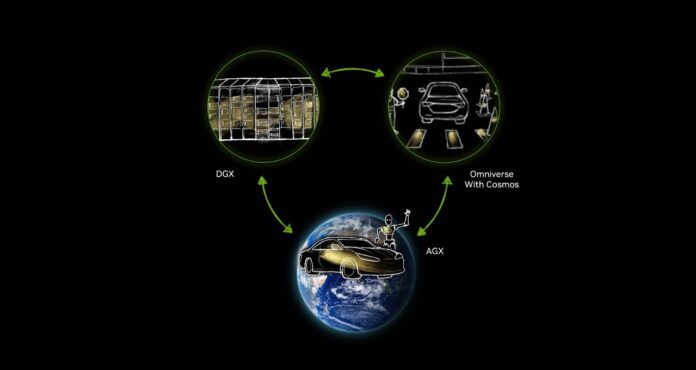

NVIDIA Cosmos 3 represents a significant step forward in the evolution of physical AI infrastructure. Announced during NVIDIA GTC Taipei, the new platform introduces an open world foundation model capable of combining reasoning, simulation and action generation within a single architecture. The launch also reinforces NVIDIA’s broader ambition to dominate the rapidly expanding market for robotics, autonomous systems and industrial AI applications.
Unlike conventional AI frameworks, Cosmos 3 integrates multimodal understanding across text, image, video, ambient sound and physical actions. Consequently, developers can create more advanced AI systems capable of interacting with real-world environments with greater accuracy and efficiency.
NVIDIA stated that the platform reduces physical AI training and evaluation timelines from months to days. Therefore, organisations developing robotics or autonomous technologies may significantly accelerate deployment cycles while lowering infrastructure costs.
NVIDIA Cosmos 3 Introduces a New Physical AI Architecture
The core innovation behind NVIDIA Cosmos 3 lies in its mixture-of-transformers architecture. The model combines a reasoning transformer with a dedicated generation transformer, allowing the system to interpret spatial relationships, object interactions and motion dynamics before generating simulations or action trajectories.
This architectural approach addresses a major challenge within physical AI development. Traditional robotics systems often depend on fragmented simulation environments and limited training datasets. However, Cosmos 3 was trained using billions of multimodal data samples, including video environments, movement patterns, sound interactions and spatial reasoning tasks.
As a result, developers can build physical AI systems with stronger real-world adaptability and reduced dependency on expensive proprietary datasets.
NVIDIA also confirmed that Cosmos 3 can operate across several functions simultaneously. The platform acts as a multimodal vision-language model, a world simulation framework and a foundation for robotic action models. Consequently, enterprises can deploy the technology across manufacturing, logistics, industrial automation and autonomous mobility applications.
NVIDIA Expands Its Position in Robotics and Autonomous AI
The launch of Cosmos 3 strengthens NVIDIA’s strategic expansion beyond semiconductor hardware into AI software infrastructure and robotics development.
The company reported that Cosmos 3 achieved leading benchmark results across multiple physical AI evaluation systems, including Physics-IQ, RoboArena, RoboLab and VANTAGE-Bench. These results position NVIDIA competitively within the emerging physical AI market, where demand for synthetic training environments and embodied AI systems continues to increase.
To support broader deployment requirements, NVIDIA introduced multiple model variants within the Cosmos 3 ecosystem. Cosmos 3 Super focuses on high-performance robotics and autonomous vehicle workloads requiring advanced physics accuracy and premium simulation quality. Meanwhile, Cosmos 3 Nano prioritises rapid inference and lower latency for real-time operational environments.
NVIDIA also announced that Cosmos 3 Edge will launch in the near future. The edge-focused version aims to support real-time inference directly on embedded systems and industrial devices.
Cosmos Coalition Expands Open AI Collaboration
Alongside the product launch, NVIDIA introduced the Cosmos Coalition, a global collaboration designed to accelerate open world model development. The initiative includes AI laboratories, robotics developers and physical AI researchers working together on shared standards, training methodologies and evaluation frameworks.
Founding members include Agile Robots, Black Forest Labs, Runway, Skild AI, Generalist and LTX. Participants will gain access to NVIDIA DGX Cloud infrastructure alongside Cosmos training tools and model development resources.
The coalition reflects NVIDIA’s broader strategy of creating an open ecosystem around physical AI infrastructure. Moreover, collaborative development may help accelerate interoperability between robotics platforms, simulation environments and autonomous systems.
Enterprise Adoption Continues to Expand
Several major organisations are already integrating Cosmos technologies into commercial AI projects. Robotics companies including Samsung, LG Electronics and Doosan Robotics are using the platform to support intelligent automation initiatives. In addition, Li Auto is applying Cosmos technologies within autonomous vehicle development workflows.
Other enterprises are deploying the platform for industrial AI applications, smart surveillance systems and spatial computing environments. Consequently, NVIDIA continues expanding its influence across enterprise AI infrastructure markets beyond its traditional GPU business.
Developers can currently access Cosmos 3 Super and Cosmos 3 Nano through Hugging Face, GitHub resources and NVIDIA NIM microservices. The company also confirmed infrastructure support from cloud providers including Microsoft Azure, CoreWeave and Baseten.
NVIDIA Cosmos 3 Reinforces Long-Term AI Ambitions
Although previous Cosmos-related announcements generated mixed short-term stock market reactions, the long-term strategic importance of physical AI remains substantial. NVIDIA continues positioning itself at the centre of next-generation AI infrastructure by combining hardware leadership with software ecosystems and simulation technologies.
The growing demand for robotics automation, synthetic data generation and autonomous decision-making systems could create significant long-term revenue opportunities for the company. Therefore, NVIDIA Cosmos 3 may become an important component within the future development of industrial AI and embodied intelligence platforms.