
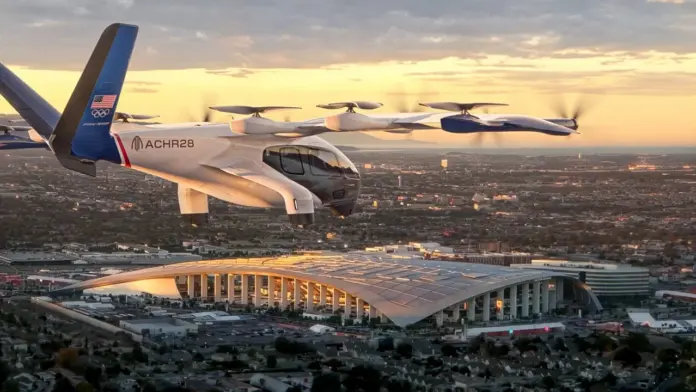

Behind the polished PR about electric air taxis and urban mobility, Archer’s acquisition of Hawthorne Airport reveals a far deeper and more consequential operation—territorial control, logistical primacy, and a quiet militarization of urban skies. The timing, the location, the players: all suggest this is no ordinary real estate deal. It’s a pre-Olympic chess move on the Californian board.
A “Green” Takeover with Geopolitical Implications
The Archer Hawthorne Airport acquisition was quietly finalized on December 9th, 2025, marking the first phase of Archer Aviation’s takeover of one of Los Angeles’ most strategically located aviation assets. Pitched as a key infrastructure hub for its future electric air taxi network, including services during the LA28 Olympics, the move is far more than a mobility story, it’s about physical dominion, regulatory leverage, and preemptive positioning in the contested airspace of Southern California.
Hawthorne Airport (officially Jack Northrop Field) lies just 2.8 miles from LAX, and is the closest airport to the SoFi Stadium, The Forum, Intuit Dome, and downtown LA. This is prime real estate in one of the most regulated, congested, and surveilled urban skies on Earth. Owning it—outright—is akin to owning a keystone in the logistical arch of the city.
Control by Lease, Then by Law
In November, Archer signed a series of binding agreements to acquire the master lease from the City of Hawthorne, along with all relevant subleases. The 80-acre site, with its 190,000 square feet of facilities (terminals, hangars, offices), is now effectively under Archer’s full operational control. That alone is remarkable for a private company in California.
But this is only Phase 1. Archer has already announced that it will acquire the FBO (Fixed Base Operator) and passenger terminal in Phase 2, expected in 2026, giving it full-spectrum control over the airport’s operations, infrastructure, and, crucially, its data.
This vertical integration, aircraft manufacturing, airfield ownership, traffic control, passenger interface, mirrors the most ambitious logistical empires of the 20th century. But with a 21st-century twist: artificial intelligence, state partnerships, and surveillance potential.
AI, the Olympics, and the Civil-Military Nexus
Archer plans to turn Hawthorne not only into a transportation hub but into a testbed for AI-driven aviation infrastructure. The press release references future deployments of AI-powered air traffic and ground operations management, a euphemism for algorithmic decision-making in spaces historically governed by federal authority (the FAA, the military, and homeland security).
There’s no transparency about who the tech partners are. But given the scope and funding environment, one could reasonably speculate names like Palantir, Raytheon, or Amazon Web Services are involved in the backend. And with the LA28 Olympic Games looming, Archer is positioning itself as a key contractor in what could become the largest urban surveillance and logistics experiment in U.S. history.
The public framing is familiar: innovation, sustainability, modernization. But underneath lies something else, a merging of corporate ambition with government necessity, producing a soft-nationalized infrastructure with private shareholders and AI at the helm.
A Silent War for Urban Airspace
The urban air mobility (UAM) sector is shaping up to be the next battlefield of U.S. tech supremacy. Joby Aviation (with U.S. Air Force ties), Wisk Aero (a Boeing-backed project), Volocopter, and Lilium are all jostling for primacy. But Archer’s move is unique: rather than betting solely on aircraft, it is buying the airspace from the ground up.
In a city as militarized and infrastructurally locked as Los Angeles, owning a legacy airport with operational autonomy and tech deployment capacity is equivalent to securing a permanent launchpad—literally and figuratively.
This also signals a shift in the federal posture toward public-private infrastructure partnerships. What used to be the domain of government contracts and base leases is now being absorbed by agile, well-funded tech firms with the right blend of innovation rhetoric and political timing.
More Than Mobility, A Preemptive Stronghold
The Archer Hawthorne Airport acquisition isn’t about air taxis. It’s about airspace dominance. About securing sovereign infrastructure before the regulation catches up. About embedding a corporate structure into the civic bloodstream of a city preparing for the world’s biggest televised event.
For now, Archer plays the part of visionary innovator. But the reality is far more complex, and worth watching. Because if Los Angeles is the laboratory, the rest of the urbanized West may soon follow.