
Davos 2026 emerges, paradoxically, as a decisive rendezvous precisely when the global order, once thought immutable, is visibly crumbling. In the heart of the Swiss Alps, under the modest theme “A Spirit of Dialogue,” over 130 countries, political leaders, and thousands of business executives gather to revive a multilateralism in crisis and hold back the tide of geopolitical fragmentation. Meanwhile, those who reject global orthodoxy quietly observe from the wings.
Trump, Economic Tensions, and a Legitimacy Crisis
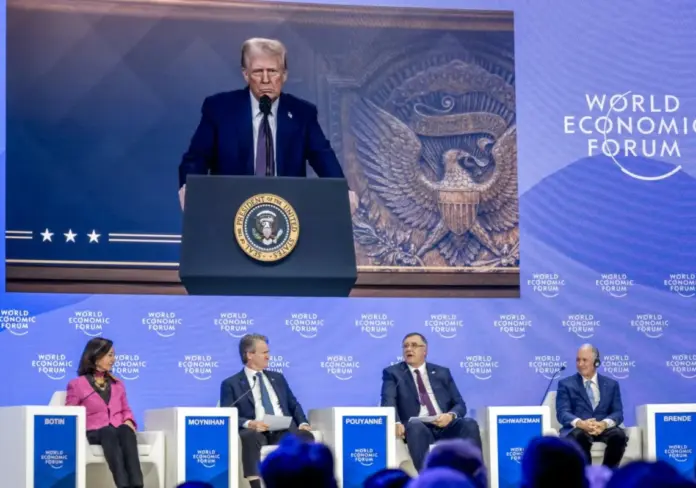
The dominant figure at this year’s Davos is, inevitably, Donald Trump, arriving with the largest American delegation in WEF history, a move that reflects the United States’ ongoing redefinition of its global posture and alliances.
Symbolically charged, this gesture encapsulates a leadership that is purely transactional. Trump weaponizes the economy: threats of punitive tariffs against reluctant European allies over the Greenland dispute, protectionist stances, and public clashes with international institutions.
The outcome is stark: economic confrontation now ranks higher than armed conflict as the world’s primary geopolitical risk, a sign that traditional diplomacy has been supplanted by tariff warfare, sanctions, and strategic supply chain disruptions.
In this context, Davos becomes a desperate stage where the survival of the multilateral order — once embodied by the forum — is being contested, with fragile attempts to preserve the transatlantic alliance, reaffirm cooperation on trade, Ukraine, and artificial intelligence.
Davos Between Illusion and Reality
To seasoned critics, particularly those skeptical of global institutions, Davos now appears as a stage for hollow dialogue where national interests reign supreme. The panels and networking sessions are little more than ritualistic attempts at coordination while a deeper reconfiguration of power blocs quietly unfolds.
In short, Davos is no longer a bulwark of global cooperation. It showcases the bitter struggle between those clinging to globalized oligarchic influence and those pushing for a more fragmented, sovereign world.
Key Economic Actors at Davos 2026
Beyond politics, businesses shape the debate over the future of the global economy and emerging technologies.
Aleria Technology and Eric Léandri
Among the key players at Davos 2026 is Aleria Technology, an AI and Big Data firm based in Abu Dhabi, and a subsidiary of the Emirati conglomerate IHC Group. The company champions technological sovereignty, delivering advanced data analytics and decision-making systems designed to preserve national control over sensitive information.
Led by CEO Eric Léandri, Aleria promotes the concept of sovereign AI, systems capable of real-time analytics, automated workflows, and leadership-grade decision intelligence, while ensuring that data remains under national legal jurisdiction.
This vision is especially timely, as AI, cybersecurity, and digital sovereignty dominate the geopolitical agenda. Aleria’s participation in a dedicated AI roundtable — alongside DDN and NVIDIA — underscores the growing demand for regional tech autonomy.
The company will host two major sessions: one with Natixis on Investing in Intelligence, and another with NVIDIA and DDN on AI in service of national strategy.
Palantir Technologies: When Data Becomes Diplomacy
Another presence impossible to ignore is Palantir Technologies, the American data analytics company long associated with military intelligence and surveillance. Its role at Davos fits a broader agenda: no longer just a tech provider, but a strategic force in geopolitical prediction and control.
Palantir now sells itself to governments as an enabler of “weak signal detection” across economic and security systems, positioning itself as a private predictive actor in a world of permanent instability. Its appearance in Davos further cements its role as a quasi-governmental partner in Western data diplomacy, an arm of chaos management, wrapped in Silicon Valley code.
A Parade of Paradoxes
Davos 2026 distills the paradox of an era where global cooperation collides with the rise of sovereign particularism. Once a consensual arena, it has become a symbolic battlefield between competing visions of world governance: a fading multilateralism versus new assertive actors — states, tech firms, regional blocs — rewriting the rules.
History may well judge this forum as the final attempt to uphold a unified world order before giving way to a fractured, transactional, and combative global system, a moment where the illusion of a “new world order” brushed up, briefly, against its brutal geopolitical reality.