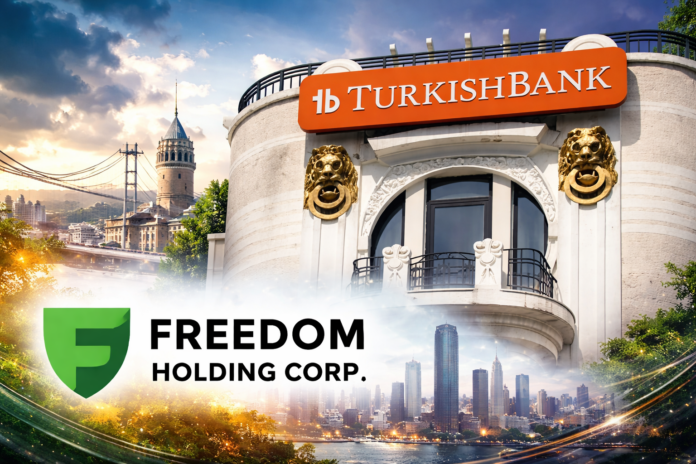

The Freedom Holding Corp Turkish Bank acquisition marks a major step in the company’s international expansion strategy. Freedom Holding Corp has agreed to purchase 99.32% of Turkish Bank A.Ş., subject to regulatory approval in Turkey.
The sellers include Özyol Holding and the National Bank of Kuwait. However, the agreement excludes TurkishBank Group operations in the United Kingdom and Cyprus.
The transaction grants Freedom Holding direct access to Turkey’s large banking market. Importantly, the market serves a population approaching 90 million people. As a result, the deal significantly strengthens the company’s regional fintech ecosystem.
Freedom Holding Corp Turkish Bank Acquisition and Market Opportunity
Turkey represents one of the largest financial markets in the region. Therefore, the Freedom Holding Corp Turkish Bank acquisition provides immediate exposure to a fast-growing economy.
Turkey’s GDP expands by roughly 3–4% annually. Moreover, the country ranks among the world’s largest economies. This environment creates strong demand for digital financial services.
Turkish Bank A.Ş., founded in 1982, offers corporate, commercial, and retail banking. Consequently, Freedom Holding gains an established platform within the domestic financial sector.
After completion, the company plans to modernise the bank’s technology infrastructure. Furthermore, it intends to accelerate digital transformation across its services.
Integrating Banking, Brokerage, and Payments into One Ecosystem
Freedom Holding aims to combine banking services with brokerage and payment solutions. Therefore, the bank will become part of the group’s broader financial ecosystem.
The company plans to integrate the platform into its SuperApp strategy. This application already offers banking, insurance, travel services, and digital commerce features.
Currently, Freedom’s digital ecosystem serves more than 11 million users globally. In Kazakhstan alone, the SuperApp has reached five million users. Meanwhile, management expects this number to rise to eight million by year-end.
Through this integrated model, Freedom intends to deliver a comprehensive financial experience. Consequently, users will access banking, investments, payments, and lifestyle services through a single platform.
Strengthening Freedom Holding Corp’s Global Expansion Strategy
The Turkish acquisition continues Freedom Holding Corp’s international growth plan. Over the past two years, the group has expanded its banking and brokerage operations across several markets.
For example, its banking division recently entered Tajikistan. In addition, the company is currently pursuing a bank acquisition in Georgia.
Meanwhile, the brokerage segment is expanding into the Middle East. In December 2025, the firm obtained a brokerage licence in Abu Dhabi.
These moves illustrate the company’s strategy of building a multi-market fintech ecosystem.
Financial Stability and Institutional Investor Support
Freedom Holding Corp continues to attract institutional investment. Major shareholders include global asset managers such as BlackRock, Goldman Sachs, Millennium Management, and Morgan Stanley.
Additionally, the company’s shares are included in the Russell 3000 Index, which tracks leading publicly traded firms in the United States.
Credit agency S&P Global Ratings recently reaffirmed the company’s B- rating with a stable outlook. Although this rating remains below investment grade, it reflects stable financial performance and continued expansion potential.
Recent financial results also show steady growth. The company reported:
- $12.38 billion in assets
- $1.40 billion in shareholders’ equity
- $76.2 million quarterly net income
- $628.6 million quarterly revenue
These figures demonstrate sustained operational momentum across Freedom Holding’s markets.
Strategic Implications for the Turkish Banking Sector
The acquisition could accelerate digital transformation within Turkey’s financial sector. Freedom Holding plans to invest heavily in technology upgrades and new digital products.
Moreover, the company intends to focus on retail customers and small-to-medium-sized businesses. These segments represent key drivers of financial innovation in emerging markets.
If regulatory approval proceeds smoothly, the bank will become a core component of Freedom’s fintech ecosystem. Consequently, the company could strengthen its position across Eurasia and the Middle East.