

Mercado Libre Q4 2025 results demonstrate a decisive acceleration in revenue growth and competitive positioning across Latin America. The company delivered net revenue and financial income of $8.8 billion in the fourth quarter, representing a 45% year-on-year increase in US dollars.
For the full year, revenue reached $28.9 billion, up 39% year-on-year, while operating income expanded 22% to $3.2 billion. Consequently, the group closed 2025 with strengthened margins and improved scale efficiency.
Mercado Libre continues to consolidate its leadership in regional e-commerce and digital financial services. Strategic investments in logistics, free shipping, artificial intelligence, and credit underwriting materially enhanced its competitive moat.
Commerce Performance Strengthens Across Core Markets
The Commerce division delivered net revenue of $5.0 billion in Q4, rising 40% year-on-year in US dollars. Gross Merchandise Value reached $19.9 billion, up 37%.
Moreover, unique buyers increased 24% to 83 million. Items sold climbed 43% to 752 million units, reflecting improved engagement and frequency.
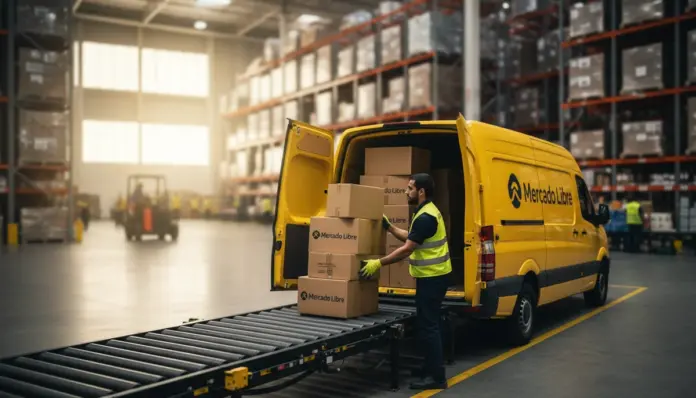
Investments in fulfilment and free shipping materially supported this expansion. Notably, 75% of fast deliveries were completed within 48 hours. At the same time, unit shipping costs declined year-on-year in Brazil, Mexico, Chile and Colombia, driven by scale benefits.
Brazil: Free Shipping Strategy Accelerates Growth
Brazil delivered exceptional operational momentum. Items sold rose 45% year-on-year, while FX-neutral GMV expanded 35%.
Lower free shipping thresholds proved instrumental. New customer cohorts demonstrated stronger retention and broader category participation. Therefore, purchase frequency increased meaningfully.
The quarter culminated in a record-breaking Black Friday, achieving the highest daily sales volume in the company’s history.
Mexico and Argentina Maintain Strong Momentum
Mexico reported 45% growth in items sold and 35% FX-neutral GMV expansion.
Meanwhile, Argentina delivered 36% growth in items sold and 42% FX-neutral GMV growth.
These results underline consistent execution across major markets.
Fintech Expansion Reinforces Ecosystem Strength
The Fintech segment, led by Mercado Pago, delivered Q4 net revenue of $3.8 billion, up 51% year-on-year in US dollars.
Monthly active users increased 27% to nearly 78 million. In addition, assets under management surged 78% to $18.8 billion.
The credit portfolio expanded 90% year-on-year to $12.5 billion. Importantly, the 15–90 day non-performing loan ratio fell to 4.4%, a historic low. Therefore, the group balanced growth with prudent risk management.
Total Payment Volume reached $83.7 billion, up 42%. Acquiring TPV grew 33% to $55.7 billion, reflecting improved merchant services and faster processing.
Artificial Intelligence Drives Operational Efficiency
Artificial intelligence increasingly underpins platform performance. AI-powered advertising tools contributed to 67% FX-neutral growth in Mercado Ads revenue.
Furthermore, machine learning models enhanced credit underwriting accuracy. The business issued 2.8 million credit cards during Q4 alone.
The Mercado Pago AI Assistant, launched in October 2025, resolved 87% of customer interactions without human intervention. As a result, service efficiency improved materially while support costs moderated.
Full-Year 2025 Financial Highlights
For the full year, the company reported:
- Net revenue of $28.9 billion, up 39% year-on-year
- Operating income of $3.2 billion, with an 11.1% margin
- Net income of $2.0 billion, representing a 6.9% margin
Commerce revenue reached $16.3 billion, while GMV totalled $65 billion. Annual unique buyers surpassed 120 million.
In parallel, Mercado Pago generated $12.6 billion in annual revenue, up 46%. Total Payment Volume reached $278 billion, rising 41%.
Strategic Outlook Following Mercado Libre Q4 2025 Results
Mercado Libre Q4 2025 results reflect disciplined capital allocation and sustained ecosystem integration. The company achieved record Net Promoter Scores across Brazil, Mexico and Argentina, reinforcing customer trust.
Moreover, leadership transition proceeded smoothly as Ariel Szarfsztejn formally assumed the CEO role on 1 January 2026.
Looking ahead, management remains focused on expanding financial inclusion, strengthening logistics infrastructure, and enhancing AI-driven capabilities. Consequently, the platform appears well positioned to capture incremental market share across commerce and fintech verticals.