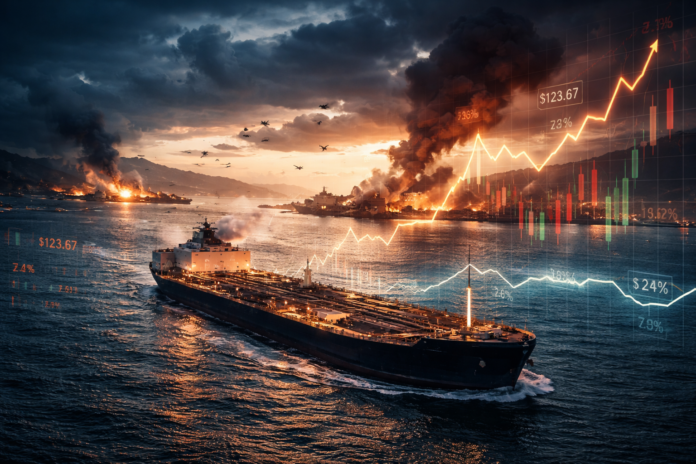

The Middle East war global economic crisis narrative is gaining traction among investors and policymakers. Indeed, the disruption of the Strait of Hormuz is unsettling global energy flows. As a result, commodity prices are rising sharply. However, does this situation truly signal the onset of a major global economic downturn?
Middle East war global economic crisis: a significant energy shock
The Strait of Hormuz remains a critical artery for global energy supply. Notably, around 20% of the world’s oil and liquefied natural gas passes through this route. Therefore, any disruption has immediate global consequences.
Since late February, escalating tensions have driven oil prices sharply higher. Brent crude surged above $110 before stabilising near $100 per barrel. Moreover, prices of aluminium, fertilisers and other commodities have also increased.
However, several mitigating factors are limiting the shock. On the one hand, strategic reserves have been partially released. On the other hand, alternative supply routes are easing logistical constraints. Consequently, the effective supply shortfall remains lower than initially feared.
Pressure on global growth, but no systemic collapse
Despite these pressures, the global economic outlook remains relatively resilient. If elevated energy prices persist, global growth may soften. Nevertheless, current estimates suggest a modest reduction of around 0.4 percentage points.
As a result, global growth would remain close to 2.8%, still above the critical 2.5% threshold. Importantly, this level typically marks the point at which global unemployment begins to rise.
Meanwhile, financial markets continue to signal cautious optimism. Interest rates remain broadly stable, while equity markets show limited volatility. Therefore, investors appear to expect a gradual normalisation.
A fundamentally different context from past crises
It is essential to consider the broader historical context. Unlike the oil shocks of the 1970s, the global economy is now less dependent on crude oil. Indeed, oil represents a smaller share of total energy consumption.
Furthermore, this situation differs significantly from the 2008 financial crisis. At that time, systemic failures within the banking sector triggered a global collapse. In contrast, liquidity conditions today remain robust.
Similarly, comparisons with the 2022 inflation surge are limited. Then, post-pandemic demand and supply chain disruptions amplified price pressures. כיום, labour markets are softer and wage growth is moderating.
Inflation and commodities: a contained risk for now
Although energy prices are rising, this alone does not guarantee sustained inflation. Typically, multiple factors must align to generate persistent price pressures.
In 2022, rising food prices and inventory shortages intensified inflation. Currently, these dynamics are less pronounced. Therefore, inflation risks remain contained at present.
However, a prolonged conflict could alter this outlook. Should oil prices approach extreme levels, inflationary pressures could accelerate rapidly.
What scenarios should investors monitor?
The key variable remains the duration of the Strait of Hormuz disruption. In the short term, markets expect a resolution within weeks or months. Nevertheless, this assumption carries uncertainty.
If the disruption extends beyond three months, the economic impact could intensify. In particular, oil prices nearing $150 per barrel would represent a critical threshold. Under such conditions, global growth would likely weaken significantly.
Conversely, a swift de-escalation would limit economic damage. Thus, the base case remains a moderate slowdown rather than a systemic crisis.
The Middle East war global economic crisis represents a credible risk, yet it remains contained for now. Indeed, underlying economic fundamentals continue to provide support. Moreover, financial markets still reflect a degree of confidence.
However, the situation remains highly fragile. Therefore, any prolonged escalation could quickly reshape the global outlook. In this environment, policymakers and investors must remain vigilant.