
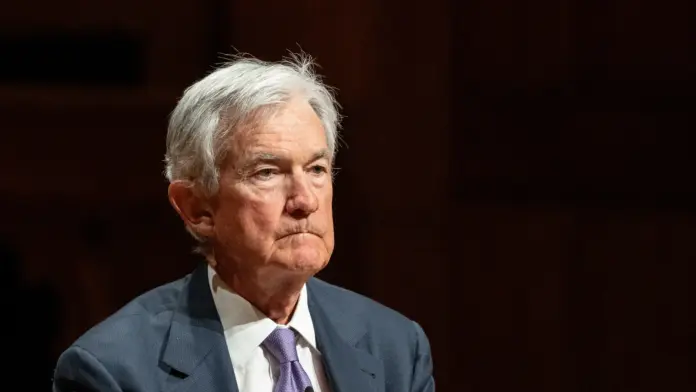

Jerome Powell Fed governor signals a rare institutional shift within the Federal Reserve. As his term as chair approaches its end, Jerome Powell confirmed he will remain on the Board of Governors.
Traditionally, outgoing chairs step down completely to ensure a smooth leadership transition. However, this decision alters that long-standing convention.
A Break from Federal Reserve Tradition
Powell’s intention to remain in office until 2028 represents a notable departure from precedent. Typically, such continuity could blur governance boundaries.
Nevertheless, Powell justifies his position by citing ongoing political and legal pressures. Therefore, he believes maintaining his role is necessary.
This stance has triggered strong criticism from the US administration, particularly from Donald Trump, who has openly challenged the move.
Political Tensions and Central Bank Independence
Relations between the White House and the Federal Reserve have deteriorated in recent months. Specifically, disagreements centre on interest rate policy.
Donald Trump has repeatedly criticised the Fed for not cutting rates aggressively. Meanwhile, legal scrutiny surrounding Powell has intensified institutional tensions.
In response, Powell reaffirmed a core principle: central bank independence must remain intact. Moreover, he stressed that monetary policy should serve economic stability rather than electoral cycles.
Kevin Warsh Named as Successor
Despite the unusual transition, succession plans are underway with the nomination of Kevin Warsh as chair.
A former Fed governor, Warsh has secured backing from the presidential majority. Furthermore, Powell expressed confidence in his successor’s ability to uphold institutional integrity.
However, Warsh’s appointment still requires final Senate approval before becoming official.
Jerome Powell Fed Governor: A Complex Monetary Backdrop
Interest Rates Held Steady Amid Internal Divisions
From a policy perspective, the Federal Reserve decided to keep its benchmark rate unchanged, within a 3.50% to 3.75% range.
Although markets widely expected this outcome, internal disagreement stood out. Notably, multiple committee members dissented, a rare occurrence in recent decades.
Some policymakers advocate rate cuts to support growth. In contrast, others remain concerned about persistent inflation and even consider tightening.
Inflation Pressures and Economic Outlook
The broader economic environment remains challenging. In particular, geopolitical tensions in the Middle East continue to push energy prices higher.
As a result, inflationary pressures persist, limiting the Fed’s flexibility. Consequently, future monetary decisions are likely to remain cautious.
Against this backdrop, Kevin Warsh will inherit a divided institution facing complex trade-offs between growth and price stability.
Governance Under Pressure
The decision surrounding Jerome Powell Fed governor reshapes informal governance norms at the Federal Reserve.
On one hand, it reflects heightened political tensions. On the other, it highlights growing challenges to central bank independence.
In the short term, markets may react to this institutional shift. Over the longer term, it raises important questions about the evolution of central banking governance in the United States.