
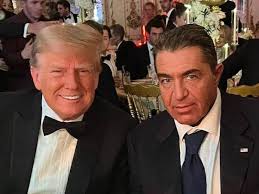

Paolo Zampolli and Trump deals now sit at the intersection of political access, diplomatic influence and high-value cross-border commerce. As investors, advisers and state-linked executives seek proximity to Washington, Zampolli has emerged as a key broker in a system where introductions, visibility and timing can carry enormous financial value.
For many in international business, access to the White House has always mattered. However, the current environment appears to reward intermediaries who can convert personal relationships into strategic meetings. In that setting, Zampolli has built a reputation for offering precisely what ambitious dealmakers want most: a direct route to the president’s orbit and to senior officials with decision-making power.
Zampolli is no ordinary political fixer. He is an Italian-American businessman with longstanding ties to Donald Trump and a public history that blends fashion, real estate, diplomacy and elite networking. He has long said that he introduced Melania and Donald Trump, a claim repeated in recent reporting, and he now holds an official role in the Trump administration as special representative for global partnerships.
That combination matters. It gives him the profile of both insider and envoy. Therefore, he can present himself not simply as a lobbyist or well-connected entrepreneur, but as a figure whose influence sits across public and private spheres. For overseas investors, sovereign interests and corporate advisers, that distinction may be especially attractive.
Why access has become a tradable asset
In modern dealmaking, information moves quickly, yet access remains scarce. Capital can be raised in hours, and mandates can shift overnight. Even so, meaningful face time with policymakers is still limited. That scarcity creates a premium around those who can arrange introductions at the highest level.
Zampolli’s reported pitch captures that logic perfectly. The phrase “$20bn in 20 minutes” is less a slogan than a statement about leverage. It implies that a short meeting, if held with the right people, can accelerate investment discussions, unlock regulatory momentum or elevate a proposal above competing interests.
Moreover, in politically sensitive sectors such as infrastructure, defence, energy, sport and real estate, official endorsement can influence commercial outcomes. A well-timed conversation may not guarantee a transaction. Nevertheless, it can alter credibility, improve visibility and shorten the path to serious negotiations.
Paolo Zampolli and Trump deals in practice
The significance of Paolo Zampolli and Trump deals lies in how they appear to merge diplomacy with transaction-making. Recent public accounts describe Zampolli as a figure who helps connect foreign business interests and political leaders to the Trump administration. At the same time, his formal government role gives those interactions a stronger institutional frame than a private introduction alone would provide.
That model has obvious appeal. International investors often want more than market access. They want political reassurance, executive attention and signals that a proposal aligns with Washington’s priorities. If an intermediary can provide those signals, his value rises sharply.
This is particularly relevant in an era of strategic industrial policy. Trade relations, sanctions, supply chains and security alliances increasingly shape corporate decisions. As a result, the boundary between diplomacy and business development is thinner than it once was. Zampolli’s role reflects that shift.
The commercial logic behind the network
From a financial perspective, the attraction is straightforward. High-level access can affect valuation, speed and perceived execution risk. A business that secures political support may find fundraising easier. An overseas partner that wins a presidential audience may gain leverage at home. A sovereign investor that receives attention from senior US officials may regard the meeting itself as a strategic asset.
However, there is a second layer. Influence businesses also trade on scarcity and symbolism. A meeting with the president, vice-president or senior envoys may generate headlines, reassure stakeholders and strengthen internal approval processes. In boardrooms, perception often matters almost as much as policy.
Consequently, brokers who can package prestige with access become commercially important. Their offering is not only entry. It is validation.
The risks around influence-led dealmaking
Despite the appeal, this model also raises difficult questions. Political access can be valuable, but it can also become controversial when the price of entry appears opaque. The more commercialised the network becomes, the greater the scrutiny from regulators, the media and counterparties.
For investors, reputational risk is one concern. Governance risk is another. A transaction that depends too heavily on one political relationship may weaken if priorities change or if public criticism intensifies. Likewise, counterparties may question whether commercial merit or personal proximity is driving the agenda.
That does not mean such networks are ineffective. On the contrary, they may be highly effective in the short term. Yet long-term institutional investors usually prefer durable structures over personality-driven channels. Therefore, any access-led opportunity still requires rigorous due diligence.
A broader shift in global business
Zampolli’s prominence also reflects a wider trend. Global business is becoming more personalised, not less. Even in an age of digital data, elite networks remain central to capital formation and strategic partnerships. Introductions, trust and political symbolism still influence where money flows.
In that respect, Zampolli represents a familiar type in a more visible form: the intermediary who understands how influence, prestige and transactional urgency interact. What is different now is the scale. If the promise is that billions can be discussed in minutes, then the market for access is operating at sovereign and multinational level.
For corporate leaders, the lesson is clear. Political connectivity has become part of competitive positioning. Yet it should be handled with caution. Access can open doors, but it cannot replace commercial fundamentals, regulatory compliance or institutional credibility.
Paolo Zampolli has positioned himself as a powerful connector in a marketplace where politics and commerce increasingly overlap. His value proposition is simple but potent: proximity to power can compress timelines, elevate opportunities and attract global capital.
Whether that model proves sustainable will depend on transparency, governance and the durability of the relationships involved. Still, one point is already evident. In today’s geopolitical economy, access is no longer a side benefit of influence. It is, in many cases, the product itself.